Category:Pelham Puppets
| Toy Brands and Manufacturers |
|---|
|
Pelham Puppets |
| 1947 - |


Pelham's "Flying Pig" trademark [image info]
The Pelham Puppets range, originally produced by Bob Pelham’s company from 1947 to 1986, mostly consisted of string puppets (marionettes) but also included occasional rod, glove and ventriloquist dolls.
Pelham were based in Marlborough, Wiltshire where Bob Pelham had settled after the Second World War with the aim of producing children’s toys. For nearly 40 years Pelham produced thousands of puppets in many designs, shapes and styles which would go on to become some of Britain's most prized and collectable toys.
History
Bob Pelham was called up to serve in the Armed Forces in 1939 at the outbreak of the Second World War. Throughout his time serving on active duty he became affectionately known as 'The Wonky Donkey Officer' due to his penchant of making small, wooden, animated donkey toys. It was his time spent throughout the conflict which influenced him to start a toy making company upon his return to Britain. After consulting Jan Bussell and Ann Hogarth (the operators of Muffin the Mule on the popular television programme) Bob set about designing puppets which would be simple enough for young children to operate and thus ---Wonky Toys Ltd--- was born; a nod to his wartime nick-name. The early operations consisted of just a few workers based in a small work shop and nearly all of the materials used in the production of the puppets were recycled, either taken from Bob's father's house or local scrap yards.
In the first months of the company Bob struggled to convince toy retailers that puppets would be a popular item to stock and he received many rejections, usually due to the perceived complicated nature of marionettes. Not to be deterred, Bob continued producing and designing his puppets and it was during this period that one of the company's most recogniseable puppets was designed: Sandy MacBoozle. This puppet would be taken from store to store by Bob and used to show potential buyers that puppets were the next big thing in the toy market. MacBoozle would later go on to become one of the company's flagship puppets. Around the end of 1947 Bob struck gold when he approached Hamley's of Regent Street, London with his puppets and they agreed to let him demonstrate them from behind his own counter. They were an instant hit and Bob later recalled "By explaining how simple string puppets really were to work and showing a somewhat surprised audience their comical antics, the first puppets began to sell!".
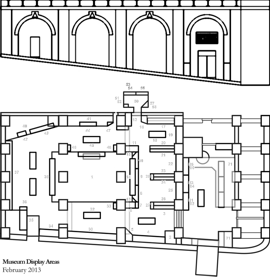
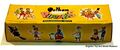
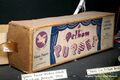
After the launch of the puppets to a big name toy store, shops all over the country began placing orders and the following years proved to be extremely successful for the company. These simple puppets, made from recycled materials and packaged in a simple brown box (an example of one of these is available to see in cabinet 53) were so popular that by 1952, a mere five years later, the company was in need of much larger premises in order to keep up with the increased production. Pelham, whilst staying in Marlborough, moved it's offices and retail store to Elcot Lane and one year later purchased a three story factory on London Road, on the south bank of the River Kennet, which would go on the become the permanent home of Pelham until 1987, when the original company ceased trading.
The Pelham company went from strength to strength and at it's peak was producing thousands of puppets in a multitude of different colours, sizes, designs and sets (see below). One of the biggest achievements for Bob came in 1953 when the company won the rights to produce a set of Disney puppets (available to see in cabinet 56). This acquisition started a pattern of fighting for commercial rights to other brands and many sets followed including The Magic Roundabout, The Muppets, Peanuts and The Wombles. All of these successes however suffered a drastic set back when, in October 1961, the London Road factory caught fire and was nearly all destroyed. Stock, materials and documents were all lost but, not to be deterred, Bob and the rest of the company set about building a new factory on the same site, as quick as possible in order to catch up with the lost time.
The 70's proved to be the the busiest decade experienced by the company and rapid expansion was required in order to keep up with the now international demand which included shipping to over 40 countries. However, despite the fact that business had never been better, it was from this time that Bob began to lose his enthusiasm due to the ever increasing commercial nature of his company; it had grown from a small office of close colleagues to an enterprise based across several premises producing at full speed, all day every day. Bob's troubles reached their worst during the 1980's when Pelham had to make several hundred loyal employees redundant due to the falling economy. After this period of decline for the factory tragedy struck when, in mid 1980, Bob died suddenly at his home. His wife Anne, who had also been a long term employee of the company and had played a huge part in it's success, continued to operate the company for the following six years until she reached the point of retirement and closed the original factory's doors for the final time.
Following the closure of the original Pelham factory and brand various companies tried, without much success, to bring back the former glory experienced in it's heyday. The rights to the name traded hands many times until it was finally purchase by once employee, and long time friend of Bob's, David Leech. This venture, although not on the same scale as the original factory, produces Pelham puppets to Bob's original designs and standards (as well as some new ones) and continues to be an ambassador for the brand.
Construction
Pelham Puppets varied greatly in the construction methods and materials used throughout the their history. In the early years Bob, as mentioned above, used mainly recycled materials found from a variety of courses as new materials were hard to come by in the post-war austerity. Army surplus parts were a common sight at first and these included wooden toggles, ammunition box partitions and even rubber respirator tubes. Puppet fabrics were often hand-dyed parachute material, and were sometimes taken from old fabric sample books and jumble sales. As business grew and the ability to find materials around the country improved, so did the quality of the puppets. Hand turned wooden heads, hands and arms were staples of production puppets up until the 1950's when, due to increased demand, a need for pre-made composite hands became apparent. Pre-constructed parts enabled a quick, assembly line process which greatly improved productivity. Because of this developmental change it is possible to estimate, roughly, in what period a certain puppet was made simply by looking at the construction style and materials used on the hands and legs. In cabinets 53, 54 and 56 there is a range of Pelham's to view which exhibit various construction materials and methods. As well as this there are also a range of boxes to view which can also be used to pinpoint when a puppet was produced.
Types

SL Rupert the Bear [image info]
Throughout the history of the company various ranges of puppets were produced. The standard type of puppet which emerged from the early 1950's, and which continued to be produced until the closure, was the SS type (SS being an abbreviation for Standard Stringed Puppet). Below you can see a more in-depth description of each type, along with the name of an examples held here at the Museum.
- SS Type
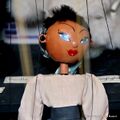
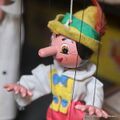
- Standard Stringed Puppet, manufactured throughout the whole life time of the company. Many of these were generic stock characters like clowns, sailors and pirates and defined by their simple round heads. However there were occasional exceptions to this rule, for example Pinocchio and Alice from Alice in Wonderland by Lewis Carroll. They were usually produced 12 inches tall and used the standard cross box control. In Cabinet 54 you can see an SS Gypsy Girl.
- SL Type
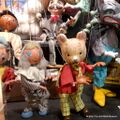
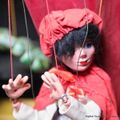
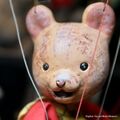
- Stringed Luxury Puppet, manufactured throughout the whole life time of the company. SL puppets are defined by their molded heads which had greater detail and visual appeal. Many of the first SL puppets were licensed characters however during the later years many characters which originally appeared in the SS line were also manufactured. In Cabinet 54 you can see an SL Rupert the Bear and an SL Wolf and Red Riding Hood (both among a group of fairytale characters which were commonly produced).
- SL 63 Type
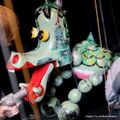
- Stringed Luxury Puppet, range first introduced in 1963. These puppets are defined by their specific designs by Peter Carter-Cage, an ex-Disney employee. The puppets were discontinued around 1966, despite their humorous designs, because of their lack of functionality making some of them collectable due to the small amount produced. You can see an example of an SL 63 Mother Dragon in Cabinet 54
- SM Type
- Stringed Mouth or Moving Mouth, manufactured throughout the whole life time of the company. These puppets are defined by their moving mouth, a feature added to make them appear more realistic. They were also top sellers and very popular amongst customers. Bob Pelham's favourite puppet MacBoozle was an SM puppet. SM puppets were a mixture of stock and licensed characters and in Cabinet 56 you can see an SM Pirate and Witch, amongst others.
- LS Range
- LS puppets were produced in the earlier days of the company, from 1946 to 1956, and resembled SS puppets but had a few differences, the two main ones being that LS puppets had 'half ball' feet rather than the fuller feet of the SS puppets and that the LS puppets had a flat control bar as opposed to the thicker square ones of SS puppets. LS puppets can be considered the precursors to SS puppets due to their age and the clear improvement in SS puppets. These puppets are usually found in brown boxes as was standard for the time.
- JC Range
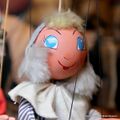
- Junior Control Range, a range of smaller puppets with simpler controls for children. These puppets are defined by their size, simple cross-bow control and round feet. You can see an example of a JC Andy Pandy puppet next to Rupert the Bear in the picture on the right.
- Jumpette Range
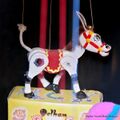
- The Jumpette range were stringed puppets which were even more simple to operate than the JC range and usually had only two or three strings with a simple control bar. The name 'Jumpette' derives from the fact that these puppets jump when the controls are moved due to the three string design. It was this feature that made them easier for children to work. These puppets came in a range of human and animal designs and an example of a Jumpette Muffin the Mule can be seen in Cabinet 54.
- Wooden Head Range
- Wooden Head puppets were first produced in the very early days of the company and were of simple construction aimed at children. These puppets can be distinguished by their simple face designs, as specialist painters were not used for these, and their wooden, flat disc hands.
- Fruit and Vegetable Range
- Fruit and Vegetable puppets were of simple design (using three strings). Production of these started in the 1980's and continued until the closure of the original company. Earlier puppets in this range can be defined by additional felt sections in the arms and legs.
- Minipups
- Minipups were stringed puppets of very simple construction and control. They were produced from 1954 to 1961 and differed from the usual puppets due to their two-string design and packaging being a simple plastic wallet. Characters produced in this range were limited to animals such as dogs and horses however both Mickey and Minnie mouse were available.
- Glove Type (GS, GL and GM)
- Glove Standard, Glove Luxury and Glove Mouth (or moving mouth). These glove puppets were produced sporadically throughout the history of the company and included a diverse range of characters ranging from licensed ones such as Mickey Mouse to Punch and Judy and from animals to the Pelham staple MacBoozle.
- Ventriloquist Type
- Ventriloquist (or vent) type puppets, produced from 1968 onward. These were more advanced hand controlled puppets with movable features for the purpose of ventriloquism. A variety of designs were available both in human and animal form. The vent dolls carried the distinctive Pelham look and were produced to order in the final years of the company.
- Collectors Type
- In 1983 Pelham announced a limited run of collectors puppets which would come with a stand and distinctive box. The first range in this series was Henry VIII and his six wives of which 1000 were to be made. Each specific set was numbered and each puppet within that set would have the number sewed inside the costume for identification. However not all 1000 were produced and it was reported that roughly 400 were made only. In addition to this, retailers did not always sell the puppets as a set and therefore finding a complete set with puppets of the same number is rare.
- Display and Professional Types
- Due to the well known nature of the company during the 20th Century, it received various orders and commissions for specific puppets for uses such as theater productions and adverts. There were also some one-off larger puppets made that were used in shop displays and as demonstration pieces. Because of the individualistic nature of these puppets most of them are now highly collectible and rare.
- Other Types
- There are some puppets that, due to their construction or design, have to be classed separate from the other categories. This does not mean that these puppets are rare or were only produced in small batches, only that they are unique in their style. For example some rod puppets were produced for licensed series, such as Dougal and Zebadee from The Magic Roundabout, however there were not enough designs to warrant their own category. Additionally they were already in a series and therefore not given additional classifications. Other puppets that are not sorted into the existing categories are the Lanky Man (LM) and Lullabelle (LL) designs due to their tall nature and also the early 'Disjointing Skeleton'. This puppet had a detachable skull and was originally made from 1952 to 1972. An example of the skeleton can be seen in Cabinet 53.
Licensed Characters
As mentioned above, the increasing popularity of the company meant that more and more other companies were willing to allow their characters and brands to be turned into puppets by Pelham. This pattern of teamwork started in 1953 with the acquisition of rights for Disney characters. Other companies that followed suit were The Muppets, Hanna Barbera, The Magic Roundabout and Peanuts. Below you will find a guide to licensed characters produced by Pelham.
.jpg)
Mickey Mouse [image info]
.jpg)
Rupert Bear [image info]
- Walt Disney
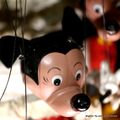
- Disney characters produced by Pelham were mostly available in SL models however there were some additional characters produced in other types. These include Mickey, Minnie and Pinocchio who were all produced as glove puppets as well and Mickey, Minnie and Pluto who were briefly available in the Minipup type. Pelham also produced some larger display models and a moving display unit was also produced for shops to demonstrate the range. A fine example of one of these Disney units is available to see in Cabinet 56. This unit includes Mickey, Minnie (pictured right), Goofy, Donald Duck and Pluto.
- Magic Roundabout
- The Magic Roundabout was a television show created by Serge Danot which was first screened in Britain in the 1960s. It was an instant hit with many of the characters becoming extremely recognisable and Bob, equipped with his experience in Disney characters, soon acquired the rights to this show. Characters produced in this line include Florence, Dougal and Zebedee and they came in a mixture of rod, glove and Jumpette types.
- The Muppets
- Jim Henson's popular tv show 'The Muppet Show' first screened in the UK in 1976 and lasted five years. During this time the show became well known and many famous celebrities of the time appeared on it. Pelham received the rights for The Muppets but only ever created two characters: Kermit and Animal.
- Hanna Barbera
- Hanna Barbera is the name of the animation studio responsible for many cartoon productions of the mid to late 20th Century. Many of these cartoons became hits not only in the USA but across the globe. Pelham collaborated with Hanna Barbera and created characters from The Flintstones, Huckleberry Hound, Pixie and Dixie and Mr Jinks and Yogi Bear.
- Peanuts
- Peanuts is the name of a cartoon strip created by Charles M. Schulz and later television programme and movie. the most recognisable characters from the Peanuts series are Snoopy the Dog and Charlie Brown. These two, along with Woodstock the bird were produced in a series by Pelham. The company also produced an animated unit with Peanuts characters much like the Disney one here in the museum.
- The Wombles
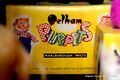
- The Wombles were a group of fictional characters created by Elisabeth Beresford in 1967 and later made into a BBC television programme of the same name. The Wombles resembled badgers and spent their days collecting rubbish from Wimbledon Common and putting it to good use. From the mid 1970s to the early 1980s Pelham produced six of the Wombles which were available in the more modern plastic fronted boxes.
Further reading
.jpg)
Cover of Pelham Puppets, by David Leech (2008) [image info]
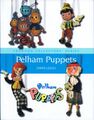
- David Leech, Pelham Puppets: A collectors' guide (Crowood Collectors' Series) (Crowood Press, 2008) ISBN 9781847970558
- David Leech, Yours Puppetually Pelham Puppet I.D. and Collector's Guide (David Leech Productions, 1996)
External links
- Pelham Puppets homepage (pelhampuppets.uk.com)
- PELPOP by collectors for collectors (pelpop.com)
- Puppets Archive - Pelham Puppets (iandenny.co.uk)
- Pelham Puppets Ltd., V&A (collections.vam.ac.uk)
video:
- Interview with Bob Pelham and a tour of the Pelham Puppets factory, ITV, December 1959 (youtube.com) – video
- Very old mechanical Pelham Puppets display (youtube.com) – video
- British Pathé: Brighton Toy Fair 1968 (youtube.com) – at ~40 seconds in, animated "Beatles" Pelham Puppets display
Subcategories
This category has the following 6 subcategories, out of 6 total.
Pages in category ‘Pelham Puppets’
The following 30 pages are in this category, out of 30 total.
B
G
M
P
Media in category ‘Pelham Puppets’
The following 22 files are in this category, out of 22 total.
 Andy Pandy marionette (Pelham Puppets).jpg 1,200 × 1,198; 637 KB
 Area 54.jpg 1,024 × 1,023; 679 KB
 Baby Dragon marionette (Pelham Puppets).jpg 1,200 × 1,200; 662 KB
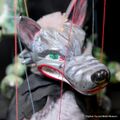 Big Bad Wolf Marionette (Pelham Puppets).jpg 1,200 × 1,200; 621 KB
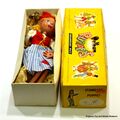 Dutch Girl marionette (Pelham Puppets).jpg 1,600 × 1,600; 388 KB
 Face, Pelham Puppets.jpg 2,500 × 1,667; 1.63 MB
 Flying Pig trademark, Pelham Puppets.jpg 959 × 1,600; 320 KB
 Gypsy Girl marionette (Pelham Puppets).jpg 1,198 × 1,200; 627 KB
 Mexican Gunfighter marionette (Pelham Puppets).jpg 1,200 × 1,200; 656 KB
 Mickey Mouse marionette (Pelham Puppets).jpg 800 × 798; 263 KB
 Muffin the Mule marionette (Pelham Puppets).jpg 1,200 × 1,200; 535 KB
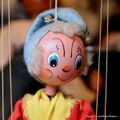 Noddy marionette (Pelham Puppets).jpg 1,200 × 1,200; 583 KB
 Pelham Puppets logo mono.jpg 2,210 × 1,302; 163 KB
 Pelham Puppets makers plaque, Disney shop-window display.jpg 1,600 × 1,067; 705 KB
 Pelham Puppets Theatre, logo.jpg 1,600 × 1,067; 852 KB
 Pelham Puppets yellow retail box.jpg 3,000 × 1,245; 657 KB
 Pelham Puppets, by David Leech, front cover (ISBN 1847970559).jpg 940 × 1,200; 366 KB
 Pinocchio marionette (Pelham Puppets).jpg 1,200 × 1,199; 550 KB
 Red Riding Hood marionette (Pelham Puppets).jpg 1,200 × 1,200; 697 KB
 Rupert Bear marionette (Pelham Puppets).jpg 1,200 × 1,200; 570 KB
 Simple Dancing Puppet, brown box, Pelham Puppets.jpg 2,500 × 1,667; 1.88 MB
 Yellow box, Pelham Puppets.jpg 2,500 × 1,667; 2.08 MB
.jpg)
.jpg)
.jpg)
.jpg)


.jpg)
.jpg)
.jpg)
.jpg)
.jpg)


.jpg)
.jpg)
.jpg)
.jpg)